Czesky Sen (Czech Dream) | documentary 41 of 100

I found this great list of 18 cult documentaries you must see, which is how I discovered this deceptively simple Czech film.

Synopsis: Two Czech film students convince an ad agency to help them pull a huge hoax: opening a fake “hypermarket.” Not only do they successfully fool the public into believing that a huge new “hypermarket” is about to open, causing hundreds of people to wait in line on the “opening” day – they also managed to fool me into expecting more of a dramatic climax than actually happened (by faking footage used in the trailer). As a viewer, you end up feeling a little bit betrayed, like the people who attended the grand opening must have felt. And aren’t films supposed to be about making you feel things? It’s infuriatingly brilliant on more than one level.

Story and Structure: Straightforward chronology. I’m envious of filmmakers who choose to make films with this obvious of a structure – it makes their job so simple. It’s a film about an event – and the obvious thing to do is begin with the idea, and how the idea is developed, building up to the event itself – the climax – and tie up a couple loose ends before rolling credits. Done.

One thing worth noting: They did NOT opt to begin the film at the obvious place: the end. I might have opened with the crowd rushing toward the fake building and then flash back to how the plan was hatched.

Cinematography: There are more glidecam shots in this film than any doc I’ve ever seen. The camera is fairly flying – in and out of crowds, circling around people multiple times, enough to make you dizzy in the hands of a less skilled operator, but this guy was ON IT. The technique called attention to itself, but that was part of the story – the idea that slick production values can sell anything. The quality of the cinematography certainly rose above that of what I’d expect from a couple of film school students. You see the one kid filmming everything with a handheld camcorder, but I didn’t see any footage in the film that looked like it had been filmed on a crappy handheld camera, so that apparently was just a prop.

Editing: The story manages to move along, despite taking a long time with arguments among members of the team who developed the marketing campaign, lots of time spent with focus group participants, etc. It appeared there must have been a ton of footage, because we get many many camera angles during the event day. They must have had a dozen camera people operating to get the coverage they got.

Sound and Music: The most memorable music was the crowd singing prior to the opening of the fake store – that was precious. Otherwise, audio was good – lots of boom poles visible in the film as they filmmakers made no effort to hide the fact that this was a film being made.
Heading to Vancouver for Larry Jordan Final Cut workshop

I’m heading to Vancouver next week on March 9 for a Final Cut editing workshop presented by Larry Jordan. The seminar cost is $99. Any Seattle filmmaker want to carpool with me? I’ll be leaving at about 6am and plan to return to Seattle the same evening by around 8pm.

I pretty much learned how to edit from this guy’s video tutorials, both those posted on his own site and via the outstanding Lynda.com resource.

This particular workshop is sponsored by Red Giant, makers of outstanding Final Cut plugins, and I’m looking forward to learning in more detail how to use their stuff in my own projects. Also a big reason for attending: Jordan will be showing tips on how to use Sonicfire, a scoring app. I’ve used it on one project and loved it, so I’m looking forward to learning more about how to integrate it with my Final Cut workflow.

Missing shutter control on your cinema DSLR? Try The Fader

The hardest thing for me to let go of in making the leap from still photography to cinematography has been the shutter speed. Losing the ability to dial that in is like losing a limb. On the one hand, you have aperture size. On the other, you have shutter speed. When you open the aperture, you increase the shutter speed. Everybody’s happy.

With cinematography, you basically get one shutter speed. Ever. Period. That’s the speed that is half your frame rate-assuming you’re going for a film look. This means that if you’re shooting at 24 frames a second, your shutter speed is always going to be set at 48th of a second (or the closest DSLR equivalent, which in the case of my Canon T2i, is 50th of a second). Yeah, I know that you CAN go all Saving Private Ryan and shoot at a faster shutter, but it’s a special effect. You can’t reach for it very often unless you’re James Longly.

So, how CAN you control light? How can you use a nice shallow depth of field in bright lighting situations when you’re stuck with what, to still photographers, is a ridiculously slow shutter speed? You COULD adjust your ISO. But that bottoms out pretty fast. On my T2i, the slowest ISO I can set is 200. If you’re in any kind of sunlight, you’ll be bumping against the slowest ISO you can set, and begging for more.

Cinematographers have solved this problem a long time ago by using something I never once used in all my years a professional photojournalist: neutral density filters. When the sun comes out, the big fat matte box appears on the front of your lens, and starts getting loaded with darkened pieces of glass. They don’t affect anything about the light except intensity – that is, they do essentially what using a faster shutter speed used to do for you (without the motion-stopping side effects).

That’s all great, except for one thing. Using ND, as it’s called, is a pain in the ass. They generally come in 4″x4″ sheets, and require a matte box that costs more than your camera to work. Then you gotta carry around a bunch of them. Then when the light changes you have to swap them out and so on.

Before I continue, I want to raise a second former-photographer gripe about DSLR cinematography. My old Nikon glass is awesome, and works great on my Canon with a $10 adapter I bought on ebay. It’s manual focus, perfect since autofocus essentially doesn’t work on DSLRs when shooting video. But when I dial the aperture, each stop clicks audibly into place. And even if sound weren’t an issue, the sudden full-stop clicks make it impossible to smoothly dial in an aperture, like you can on professional video cameras, which have a continuous smooth iris ring. So we’ve got two serious problems that suck pretty bad. Wouldn’t it be cool if you could regain some of the control you gave up with the shutter dial AND fix the aperture click issue by adding one small piece of gear to your kit?

Enter “The Fader.” After using it for just one day of shooting, I call it something else: The Holy Grail. It’s a filter that looks a lot like a polarizer, with two rotating panes of glass. Only when you rotate it, it gets darker. A LOT darker. In cineamatography terms, it goes from ND 2 to ND 400. Wow. That’s hardly anything to almost complete darkness. And it does it smooooooothly as you can rotate it. See why this is so cool? Because it allows you to set an aperture, say 2.8, and when the sun comes out, you just twist the dial, like you would twist the aperture ring on a video camera, to chill down the exposure to something perfect.

In practice, it’s best to do this between takes. But the fact is, I actually was able to dial in the exposure while rolling using this instantly indispensable tool. It’s got nice grooved edges that make it easy to smoothly twist, and it’s MUCH easier to adjust on the fly than cranking on the clanking aperture ring of my Nikons.

I already feel naked without one of these on the front of my lens. I like these so much, I’m buying one for each of my primes (20mm, 35mm and 50mm). I plan to leave it permanently on the front of each lens (except when I absolutely need every stop out of the lenses when shooting in low light).

Thanks to Ryan Bilsborough-Koo for turning me onto this crazy-sexy device on his outstanding DSLR Cinematography Guide.

Editing project: SAM event promo shot on Flipcam

My entrepreneurial friends Piper Salooga and Sara Eizen, who both run their own interior design firms (Natural Balance Home and Office and Nest), teamed up with the Seattle Art Museum to host an event on March 11 at the museum gift shop. Full of can-do, they grabbed a Flipcam and decided to shoot their own video to promote the event. Then they called me and said, “Hey, we’ve got all this video…but we’re not sure what to do with it.” Here’s the result of my first editing project using someone else’s totally novice, handheld video. Not bad, huh?

Color grading (the dreamy tilt-shift in the intro and filmic-color throughout) was applied with Magic Bullet Quick Looks, an awesome plugin for Final Cut. For the music I used Sonicfire, a killer music-for-video service that lets you choose from a huge rage of beat-matched tracks. The killer part is that you download the track, then select exactly how long you want it to be, and it automatically outputs the precise length you want – with exactly the instrumentation you want (ie, you can lose the vocals, kill the drums, etc – all the the instruments are on their own layer). For $19 bucks a pop. Killer.

I used two special effects transitions – a whip-pan effect from Digital Heaven, and a flash filter that you can learn how to do in this video tutorial.

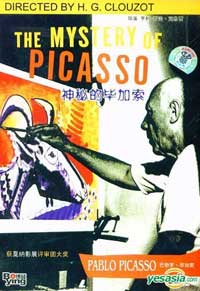
The Mystery of Picasso | documentary 40 of 100

Where does art come from? It’s a mystery, for sure. But one that can be recorded on film. French director Henri-Georges Clouzot captures Picasso’s process with what at the time may have been innovative techniques of time lapse, but that today seem a tad simplistic. But if you’re a Picasso fan, it’s enchanting.

Synopsis: Using a process that involves colors bleeding through paper to reveal pen strokes as they happen, the filmmakers join Picasso in his studio to observe how he puts ink and paint on canvas.

Story and Structure: The film is simply a visit to Picasso’s studio, in which he performs a series of paintings specifically for the camera, from beginning to end. A handful of brief interludes in which the director converses with Picasso add much-needed breaks from the tedium of watching paintings slowly emerge. It concludes with Picasso signing his name on a big canvas, and walking away.

Cinematography: The technique of ink bleeding through paper is interesting and a mystery for the first part of the film until it’s revealed when the director of the film inserts himself and his crew into the production in a conversation with Picasso. There’s a scene in the film, apparently inserted to add dramatic effect, in which the camera is about to run out of film, and we see the feet running out. But it seems fairly contrived. Lots of time lapse, which is kind of tired by the end.

Editing: The edit emphasizes the art, to the exclusion of Picasso himself.

Music: The music is frenetic, and all over the place. I’d have rather heard Picasso musing about his work in voiceover, instead of all that music and very little spoken words in the film. But the music does match the painting pretty well perfectly, complete with flourishes at end. A little too perfectly.

The director in this film seems a little high on himself. He dominates the conversation with Picasso, and smokes a pipe in Picasso’s studio. I was a little embarrassed for him.

The September Issue | documentary 39 of 100

I’ve been head’s down editing a commercial piece for Eton School over the past week, which I’ll be posting as soon as it’s approved and we clear the audio track. I came up for air last night long enough to screen The September Issue with my wife. It’s the first documentary film in this series of 100 that I intensely disliked.

Synopsis: A soulless behind-the-scenes look at the inner workings of Vogue Magazine and it’s editor-in-chief, Anna Wintour. This film made no sense to me at all, until my wife told me that it was a response by Anna to critics who say she’s a militant bitch. It does little to improve her reputation, in my opinion, but at least this explains why it was made: it’s basically a feature-length PR stunt. Or to put it more simply, crap.

Story Structure: The film is structured around the 6-month-long process of producing Vogue’s largest issue, which is published each year in September. Unfortunately, the story train just isn’t interesting: of course they will meet their deadline (it’s Vogue, duh, did you have any doubt they would?) There’s some comedic relief in seeing the world of mostly cowering minions that Wintour has created for herself to live in, and the frustration on the part of her assistant editor who actually does the real heavy lifting to produce the magazine is palpable.

Cinematography: The quality of the video often was disappointing. Highlights were often blown out, and there was plenty of searching for focus happening. I got the sense it was shot with a crappy camera and included sloppy camera work so that it “looked” like a documentary, possibly because of some brisk decree issued from Anna Wintour to make it seem more believable.

Editing: There’s some nice cutting in this film, for example, the way in which we go very quickly from someone talking about a runway show straight into the show with just a few steps in between.

Sound and Music: The thing I liked most about this film was the music. The energy of the runway scenes brought the film to life with pulsing electronica. Of course, all warmth generated by said scenes was immediately drained when the camera inevitably settled on Anna Wintour.

After this, I’m looking forward to screening “Valentino: The Last Emporer” for another take on the fashion world.

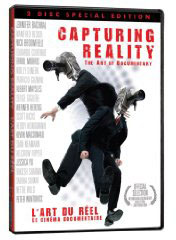
Capturing Reality | documentary 38 of 100

Cinematographer Steven Bradford came over this evening and we screened Capturing Reality: The Art of Documentary. It’s a 2-dvd set with a feature length doc on one, and nearly 4 hours of interviews with 38 documentary filmmakers on the second disc. The whole thing is produced by the National Film Board of Canada, an organization the supports Canadian filmmakers. When I was a kid growing up in Alberta, my dad would rent 16mm films from film lending libraries that the NFB made available in Calgary. He’d bring them home, and I’d play projectionist. That was movie night for our family.

The website for this film is the best documentary film site I’ve ever seen. It’s got part of the soundtrack playing, and you can roll over any of the 38 directors to play cuts of them talking about their approach to filmmaking.

Synopsis: Documentary filmmakers strive toward truth in one way or another, working with real lives and real events in the way that narrative filmmakers work with actors and costumes. But both approaches are manipulations. In interviews with 38 filmmakers, including Academy Award winner Errol Morris, Capturing Reality shows that there are as many approaches to making films as there are filmmakers.

Story Structure: This is an interview-driven film, a film that perhaps only filmmakers will really love. Intercut with the interviews are clips from many of the films being discussed. It’s thematically organized by major components of filmmaking, for example, Sound, Editing, Cinematography, Narration, Ethics. In particular, I loved the probing sections about what led them to become filmmakers, and how they decide on which ideas to turn into films.

Cinematography: Almost all of the interviews are shot and lit identically, in 3-light setups against black. I’m not sure that was the right choice, frankly – I would have liked to see something of each filmmaker’s environment if possible (although it’s possible the film was shot at a festival or something which would have made the environment meaningless). This approach DOES focus your attention exclusively on what the directors are saying, rather than their surroundings, which means content is king in this film. And the result is an treasure trove of ideas, tips, techniques and anecdotes, uncovered so rapidly that it begs for a second viewing. A nice touch at the beginning is catching the editors while they are putting their mics on, saying off-hand things. Sets the tone for what’s coming in the film.

Editing: The editor did a great job of in some places showing directors talking about their own films while at same time showing a clip from film, but often showing another director referencing another filmmaker’s film and showing that one. Or showing a clip that wasn’t specifically referenced by what’s being said, but works anyway. In many cases the directors say essentially opposite things, and the cuts show the diversity of opinion rather than attempting to enforce agreement in the edit, which felt true. In other places, directors nearly complete each other’s sentences, which really pulls the film forward.

Music and Audio: Great audio on the interviews, as one might expect from the controlled conditions they all were filmed under. The minimalist orchestral string-heavy music that runs under much of the film reminded me of Errol Morris’ recent films (but it’s not Philip Glass – although there are some clips of Glass from a documentary made about his life). One interesting audio fact: On “Touching the Void,” Kevin MacDonald’s sound guy came up with the sound used in the ice crevasses by slowing a leopard’s grown down 50 times. The result is an eerie, spooky sound that was perfect. Herzog had a great quote: “Music gives new insights – a different kind of vision.” By contrast, a couple of directors said they think music has no place in documentary. I side with Herzog.

This amazing film also turned me on to a whole bunch of films that I haven’t seen, which I can’t wait to get my eyes on: “Lessons of Darkness;” “The Peacekeepers;” “Salesman;” “The Scavengers;” “Metal and Melancholy;” “The Bomber’s Dream;” “Darwin’s Nightmare;” and directors like Scott Hicks, and Jessica Yu.

I’m not sure who said this, but it was one of the female directors in voiceover during a clip, and it’s the line: “The films that we make are our teachers.” But Velcrow Ripper got the last word: “The answer to life is becoming a documentary filmmaker.” Here here.

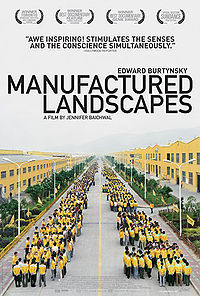
Manufactured Landscapes | documentary 37 of 100

Manufactured Landscapes is one smart documentary. Let me count the ways: it manages to take us from beginning to end without a single on-screen sit down interview. It’s got a haunting, techy, glitchy original soundtrack. It manages to make a huge political statement without being preachy or even taking an overt position. But most of all, it’s simply breathtakingly to look at. I saw Jennifer Baichwal’s latest film at SIFF Cinema last fall, Act of God, and it’s also a visual orgasm.

Synopsis: Canadian nature photographer Edward Burtynsky photographs the landscapes of the Earth that have been transformed by human activity to reveal a haunting picture of the modern world, and filmmaker Jennifer Baichwal weaves his pictures into a compelling visual poem.

Story Structure: A non-linear journey in which the filmmakers accompanied Burtynsky as he made his way around the world filming, from China to Bangladesh, intercut with current art exhibitions of photographs made on this trip. This overt playing with time combined with otherworldly soundtrack is like dreaming. The elements of story are provided without narration, with voiceover from the photographer who at no point is interviewed (although at one point is seen talking on stage explaining his work to an audience).

There’s also a rather strange sequence in the final third of the film in which a Shanghai real estate agent is essentially narrating the story of Shanghai. On balance, though, this is just brilliant filmmaking: eschewing traditional interviews in favor of endless, humongous images, in an open-ended meditation that leaves the viewer to draw her own conclusions.

Cinematography: In a word, HUGE. The opening sequence is an unforgettable 8-minute long tracking shot of a factory floor in China that assembles clothing irons. Reaching the end of the line the frame wipes to a still photo of the same factory floor, which then becomes the title of the film.

There’s a bunch of black and white footage in the film that was obviously shot by someone else – presumably they ran it in black and white to show that it was shot by someone other than the filmmakers. I did some googling and found out that another filmmaker, a rookie documentary filmmaker, had shot 80 hours of footage hoping to make a film, but Burtynsky wasn’t happy with the results, so he hooked up with Baichwal, who also hails from Canada.

There’s one dutch camera angle in the film that is a judicious use of the heavy-hammer technique: it’s used to show a container being lifted off a truck and hoisted onto a ship.

Editing: The way the editor linked the still photos to the moving pictures was sick. The first time this happens is with the shot of the workers lined up in front of the factory. It works like this: 1. shot of Burtynsky taking film out of his camera. 2. Still photo that results. 3. begin zooming out … and we realize that we’re in an art gallery as someone walks in front of the photo. All of this with J edits that had sound from one overlapping the next scene. Damn. That’s HOT.

In general Baichwal likes to use cuts that dissolve slowly into each other at different angles while the camera is traveling. For example, there’s a memorable dissolve between an angled tilt shot over a city scene from above, which is slowly dissolved into an oppositely angled tilt shot of a model city. She uses this type of edit a lot in Act of God, in which she’s tilting into treetops and cutting them together into a dreamy montage.

Music and Sound: Techy, glitchy, minimalist music is a perfectly discordant match for the pictures and images in the film. Some of it sounds like it was made from samples recorded at the scenes – jets of gas recur in music sounding like work on an assembly line. The way that found sounds creep into the edits is brilliant – for example, the “beep, beep” of the huge cranes at the port lifting containers off trucks and loading them onto container ships. You hear the beeping long before you see the crane making the sound, and I think it was in fact foly generated and then matched to the actual track because of background noise in the shot. Nicely done.

This film is an inspiration that I’ll be thinking about for a long time.

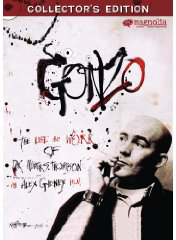
Gonzo: The Life and Work of Dr. Hunter S. Thompson | documentary 36 of 100

I wonder how many journalists became journalists because of Hunter S. Thompson? At the student newspaper when I was a journalism student at University of Montana, we’d spend hours debating his style late into the night, usually over beers. But the reality, I quickly discovered at my first newspaper job, is quite different. Journalists generally quietly support the status quo with stories that rarely challenge anything other than our ability to remain interested in what they have to say.

Synopsis: Few journalists have made a greater impact on their readers than Hunter S. Thompson, whose “gonzo journalism” defined a generation from the pages of The Rolling Stone. This film recounts that as well as his less well known life as father, a gun-lover, and a world-class celebrity who ultimately felt trapped by his own success, but who always followed his own eccentric path right up to his suicide in 2005.

Story Structure: Mostly linear and chronological story of his life, but with the frequently used device of beginning at his death, and then skipping back to the beginning, the progressing through his live to end the film at his spectacular funeral. I’m not sure how well this type of beginning works, actually – if there was something cliffhanger about his death, or something that was unexpected or in doubt, this approach would have worked better. But I suppose it’s better than just starting at the beginning – that’s even more predictable.

What I’m trying to say is: there’s nothing innovative about the way this film is structured – and it works just fine. It uses still photos, family film clips, tv news footage, and interviews with important figures like Jimmy Carter, Rolling Stones editor Jann Wenner, Pat Buchanan, and many others. The fact is, this film is exactly what it claims to be: the story of the life and work of Hunter S. Thompson. Nothing more, and nothing less.

Cinematography: Most of the film is a compilation. This is a classic “archival film.” But there are plenty of interviews, which are shot unremarkably in mostly natural light in the offices of the people being interviewed. But they get the job done nicely.

Editing: Editing was the big job on this film. How to pull all that archival footage together to tell a cohesive story? That’s the trick. And it’s done very well in this film. But without discernible innovation. One memorable edit: Thompson shoots his typewriter – which functions as a metaphor for him shooting himself. Great way to handle it.

Sound and Audio: There’s one really fun bit of audio accident that made it into the film: At one point during an interview with Pat Buchanan, an extremely loud Harley motorcycle blasts off outside the window where the interview is taking place. Buchanan pauses, laughs, and says “I think that’s perfectly fitting, isn’t it.” Music is all period songs from the likes of Lou Reed, James Brown, and Bob Dylan. Must have been a hefty price tag on getting all those clearances.

Nanook of the North | documentary 35 of 100

I decided to screen Nanook of the North for one reason: it was the first feature-length documentary film ever made. I didn’t expect to get much out of the screening, figuring it would be just a bunch of clips strung together predating the arrival of using the medium to tell stories. But I was wrong. In fact, as Robert Flaherty explains through heavy use of intertitles (the silent-film era’s way of explaining things), he in fact DID make a film of that kind, and was unsatisfied with the results, so he returned to visit the Eskimo people who live along the eastern shore of Hudson Bay to create a film with a story worth telling. And that’s exactly what he did.

Synopsis: Robert Flaherty spends more than a year filming one Eskimo family in northern Quebec, and introduces us to Eskimo life via their story. The family overcomes a series of hardships – lack of food, cold weather, dangerous ice – but Nanook, the “great hunter” saves the day.

Story Structure: This is much more than a simple “document” of life in the frozen north. It is a story structured as a series of life-threating obstacles which the family must overcome. Conflict comes from dramatizations of hunger, cold, and need to hunt animals to trade. The difficulty of life is sharply pictured, but at the same time a picture of a simple, solid family that lives in harmony with the Earth emerges.

Cinematography: The film opens with a tracking shot taken from a boat – moving past chunks of ice. It’s actually quite beautiful. One thing that struck me right away was the fact that this was filmed in extreme conditions! How surprising that the very first documentary film was shot somewhere so extreme. I would have thought someone would document something in their back yard first? So from the beginning, filmmaking has been about “the other world.”

There is also striking pathos in this film. For example, when Nanook harpoons a walrus, for a long time the walrus cries for its mate, which risks its own life to try and lock horns with the doomed walrus and help it to safety. It was a touching moment that spoke volumes about how close animals are to Eskimos and in fact how attached they are to one another and how brutal it is to kill them. An even more brutal scene occurs when Nanook traps a white fox, and straps it to his sled ALIVE, where the children pester it. You can’t help but feel terribly sorry for the creature, which is essentially being tortured before ultimately being killed.

Editing: There’s a lot more going on here than I would have expected for a film this early on. For example, the film opens with the entire family being disgorged from the mouth of a kayak that appears far too small for them all to fit into, which makes me think he was using some editing magic for comedic effect. Same thing in the scene where he harpoons a seal – which is followed by a lengthy scene in which he falls down repeatedly on the ice while waving madly for his friends to come help. This was almost certainly inspired by Charlie Chaplin, and totally staged.

One thing that surprised me is that this very first film contains animated maps. The animation is simple – just lines spreading out into the map to show the territory of the Eskimos. Nevertheless, animation as a storytelling device dates from the very beginning of documentary film. It’s clear that Flaherty wasn’t content to simply point his camera and document – he wanted to communicate and tell stories.

Music and sound: It’s simple, because there was no sound in those days. The music, though, is carefully cut or composed to match the on-screen action. For example, there’s a comical scene in which a trader plays a gramaphone for Nanook, who acts like he can’t figure out where the sound is coming from (also almost certainly staged). But the music interrupts to match the interrupted music on the screen, and so on. Also, plucking strings in the orchestra when Nanook is jigging for fish is nice tie-in. Essentially what was happening in those days was that the orchestra was matching their performance to what was happening on screen.

The Criterion Collection version, which I viewed, had an extras segment featuring an interview with Flaherty’s wife, who explained that Flaherty was “an explorer first and a filmmaker way after.” In fact, Flaherty was almost 40 years old when he made the film. Which gives me great confidence that 43 years old is not too late for me 🙂