Zachary Levy: Truth Matters

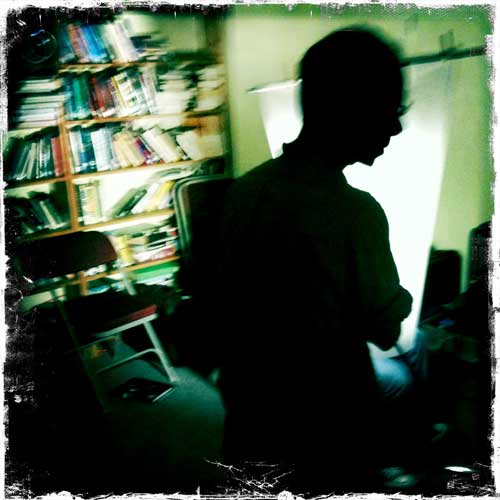
Documentary filmmaker Zachary Levy

I had the privilege of participating this afternoon in a cinéma vérité workshop taught by documentary filmmaker Zachary Levy. He’s in town for the Seattle screening of his first feature documentary, 3 years in the making, Strongman. It opened last night and deserves a much bigger audience than the handful of people who showed up to see it last night at Northwest Film Forum (I’ll be blogging a filmmaker review of the film soon).

As a cameraman on big shows like Oprah and 60 Minutes, Zach has a ton of experience in how NOT to make the kind of films he wants to make. Citing influences like Al and David Maysles, Zach pursues a simpler, “truthier” style in his own filmmaking known as cinéma vérité.

Eschewing even common cinematic accompaniments such as music (there is only one song in Strongman, and it accompanies the credit roll), Levy strips artifice to the bone, leaving his characters with nothing to be but themselves. To make this kind of film, Levy says, you want to find a subject who WANTS something – the stuff of classic character-driven plot. Then you start shooting, and trust that what happens will be interesting. Levy compared this approach to filmmaking with a jazz musician’s improvisational approach to music: the notes that are in front of you determine the ones you play next.

Here’s 12 things I learned from Levy today:

1. Hold the Shot. When you THINK the action is finished and you’ve got it, force yourself to count to 10. Something even more perfect just might happen, OR you might get something that will make your edit easier.

2. Wear long pants. Translation: be willing to use your body to get the shot. That means kneeling, standing for long periods of time, stretching beforehand, getting physical with it.

3. Keep your camera close. Simple body mechanics, but something I’ve overlooked: when you hold the camera in your hands actually touching your stomach or chest, it’s not only braced and more stable, but it’s better supported, so you can shoot much longer without getting tired.

4. Always shoot SHOTS. That is, think like a still photographer and frame things so they look good. That doesn’t mean going all “Living in Oblivion” style. But do shoot pretty rather than just shoot.

5. Look for the conflict. Stories that make for good verite involve conflict of some kind. In the case of Strongman, the conflict was mostly internal.

6. Shoot first, get releases later – if at all. Learning this one fact was worth twice the price of the workshop. As a former photojournalist, I have a solid working knowledge of “fair use” doctrine. But I’d been led to believe by other filmmakers that since films were commercial in nature, different rules applied. That turns out not to be the case with documentaries. Get releases when you can, he said, but don’t let NOT having them stop you from making your film. Got it.

7. Use signs as a form of narration. Levy included a brief “welcome to Orlando” sign in one scene as a way of revealing to audience where the action was happening, since the film has no narration.

8. Use visual metaphors. In one scene, Levy consciously includes a clock in the background to emphasize the fact that time was passing as one of the characters celebrates her birthday.

9. Watch the line. It’s an established filmmaking convention to keep characters on the same side of the frame throughout a scene, to avoid confusion about who’s who. You can break this convention, but be aware of it, and do it consciously for a reason.

10. Watch for repeat behavior. People behave predictably – so observe that and use it to your advantage. Over the years of filming, he came to know exactly where Stan would sit, and was able to make subtle adjustments  to the table beforehand so that light would fall just enough to light the scene without Levy having to intervene.

11. Keep lighting simple. Levy was able to get acceptable levels of light in most of the scenes in Strongman by simply replacing the standard 60-watt bulbs with 80- or 100-watt bulbs. Side benefit: the natural light of the place was preserved, and he didn’t have to do any additional work to light the sets. Drawback was he had to use a big shoulder-bourne camera that was capable of shooting in low light. (That is less true today with small cameras with fat sensors like the Canon 5d).

12. Sound guy should “fade away.” Levy’s crew consisted of just one person – a person to record sound. And he made clear to this person that he or she was not to make eye contact with the subjects, as much as possible, so that there wasn’t any relationship developing that would show up on camera and have to be edited out.

Levy’s teaching another workshop tomorrow from noon-3pm, which I’ll attend and blog. Meanwhile, if you’re interested in seeing what a Slamdance-winning cinema verite film looks like, don’t miss this chance to see Strongman – it’s showing at NW Film Forum through Jan. 14.

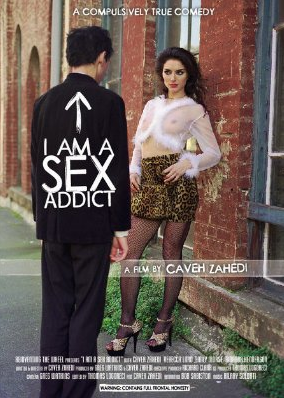
I Am a Sex Addict | documentary 6 of 100

This carefully crafted film doesn’t fit easily into any genre, which is part of why I like it so much. Filmmaker Caveh Zahedi uses direct address throughout the entirety of I Am A Sex Addict. And he  mixes actual footage of his past girlfriends with actors portraying them to tell the story of his life through his relationships with women, wrapping it up neatly with a significant real-life event at the end (at least I THINK it was real, although with this type of film you never really know).

I admire filmmakers who are as comfortable in front of the lens as they are behind it. I’m not. It’s quite a talent to bare your soul in a way that is entertaining and informative. As someone who has spent (and still spends) a ridiculous amount of time mentally undressing women, I would say that what Zahedi is doing in this film takes almost as much courage as what James Longly does in his.

Technical observation: There are briefly animated scenes that show the characters flying across the Atlantic, really simple, just stylized head shots of the characters flying over a map. It works. And in some of the acted sequences, Zahedi looks at the camera and reveals that the scenes aren’t really where they purport to be – which is endearing and somehow makes the rest of the film more believable.

When looking for ideas to turn into a film, it’s tempting to think “life is elsewhere.” I’m a big fan of filmmakers who can take something that is right in front of them, and turn it into a compelling story. Zahedi certainly has done that with this film. That’s the takeaway, perhaps: good films are made with ingredients that are right in front of you.

I’m reading a book right now called Making Documentary Films and Videos by Barry Hampe. The author devotes a lot of space in the book to defining what a documentary is and what it isn’t. For him, documentaries are more related to journalism than they are to Hollywood. “The difference between television journalism and serious documentary filmmaking is the difference between a newspaper article and a book,” he says.

According to Hampe’s definition, a film like this is clearly not a documentary. And Hampe is quick to dismiss even Michael Moore’s films as “Docuganda.” But I disagree. I think it’s up to every documentary filmmaker to define the word for themselves, and let their reputation speak for itself. If, like Hampe, you want to keep both feet squarely planted between the goal posts of verifiable fact, go for it. If you want to take me on a fact-based flight of fancy, I’m down for the trip.

The War Tapes | documentary 5 of 100

Seattle documentary filmmaker Nassim Assefi brought over a Netflix dvd of The War Tapes a couple nights ago. Watching this film so quickly after watching Iraq in Fragments was an interesting juxtaposition. This is a very different take on the Iraq war: the world as seen through cameras given to National Guard soldiers deployed to Iraq by filmmaker Deborah Scranton and her team, which included Hoop Dreams director Steve James, who was producer/editor on this film.

I’m guessing the editor had the toughest job on this film, as the bulk of the film was cobbled together from footage that was sent home to the filmmakers by the soliders. I guess that’s what some people would call innovative filmmaking. This film certainly tells a fully developed story that probably couldn’t have been told any other way. But compared with the work that James Longly produced at the same time in the same place, I’m tempted to call it inferior filmmaking. The difference, of course, is that James was there, actually making the film himself, while the War Tapes filmmakers were at home, reviewing footage produced by soldiers. It’s a very different approach, with very different results.

The filmmakers do actually make a bit of film themselves, though, beginning with the soldiers themselves before they are deployed to Iraq, and also following them after their return long enough to find out that they have (surprise surprise) been changed by their experiences.

The point of view of this film seems to be “soldiers are people, too.” Or maybe, “soldiers are victims of this war as much as anyone else.” But I found the soldiers to be pretty unsavory characters who made bizarre choices in life. After the inevitable horrors they encounter (seeing an Iraqi girl run over by a convoy they were protecting, killing iraqis and generally being afraid for their lives the whole time they were there) they come home and half of them end up quickly diagnosed with post traumatic stress disorder. But my feeling after watching this film is that these guys were not victims of Bush’s war machine as much as they were willing accomplices.

From a filmmaking perspective, this film proves that it’s absolutely possible to make a compelling, highly engaging film using the work of amateurs, provided you’ve got a dedicated team of talented filmmakers managing the process from beginning to end. This film is sort of a natural extension of the basic idea behind Born Into Brothels – giving cameras to kids. No doubt we’ll see more of this kind of filmmaking as good quality, inexpensive video cameras become as ubiquitous as cellphones.

Rivers and Tides | documentary 4 of 100

If there’s one thing I’ve learned about art after 7 years of going to Burning Man, it’s that the process of creating art is far more interesting than the product that gets created. To say this another way: going to a museum to look at art is a little like going to a zoo to look at animals.

In Rivers and Tides, Thomas Riedelsheimer shows us art in the wild. Literally. Scottish artist Andy Goldsworthy creates sculptures from objects he finds in their natural environment – everything from chunks of ice to stones to tree branches. And the results are absolutely striking to look at – for a little while. Until the tide covers it. Until it melts. Or until it collapses from the weight of one too many stones.

The cinematography in this film is as beautiful as the art itself. It’s like Reidelsheimer is undressing the art with his camera. He makes frequent use of a crane to glide into, over and around the art. Much of the film was made in rugged outdoor conditions – for example, the middle of frosty fields and muddy rivers. So packing a crane around can’t have been easy.

I’ve never seen a crane in action, but watching the slow, fluid movements a crane makes possible makes we want to try it. I did some Googling and found that you can buy a decent camera crane for around $1,500. But then you should probably add a field monitor, and a way to control the focus and on and on. Plus you’d have to assemble the thing, take it down after after every shoot, etc. It’s a commitment.

Filmmaker takeaway: You can bring a subject to life by approaching it with your camera like a patient lover.

Iraq in Fragments | documentary 3 of 100

What’s incredible about this Oscar-nominated film is that it appears to have been made almost singlehandedly by a lone white guy, James Longly. He was born in Eugene, Oregon, but apparently hasn’t spent much time there over the past several years. Instead, he’s been living in places like Iraq (where he spent 2 years making this film); Iran (where he was arrested during the election last year), and he’s currently doing more of the same in Pakistan.

The first thing that struck me, as a filmmaker, about this extraordinary film is the way the opening sequence was shot – in fragments – by simply pointing the camera out of a vehicle traveling down the street with a fast shutter speed of maybe 250/second, which gives you a stuttering sequence of still frames strung together. It’s a technique popularized by Hollywood films like Saving Private Ryan and Traffic, and it works extremely well here to show that we’re entering a chaotic world.

There’s a shot early on in the film that I won’t forget for a long time: a sketchy street seen through a fish tank in which a pair of breathtakingly orange goldfish are floating. The contrast is unbelievable. It’s just an incredible shot that, if you got it, it has to go in the film. Reminded me that no matter where you are, keep your eyes open for things that don’t to fit within the paradigm of  everything else you’re keying on.

The most significant filmmaker take-away from this film is that it’s possible to include interviews in your film without including interviews. I’ll explain. In the first two-thirds of the film, at no point does the voice of the person being interviewed match with an interview happening on screen. Yet, we’re often seeing the person who is talking – only in different (but frequently related) situations. For example, the first person we get to know in the film is a young boy, who works for an abusive boss at a small car and motorbike repair shop. We hear the boy’s voice for a long time before we actually meet the boy, and when we meet him, it’s not in an interview context. He’s essentially giving us a voice-driven commentary about how awful his boss is, while at the same time we’re actually seeing how awful his boss is.

This is an extremely effective way to include interviews without forcing the audience to sit through predictable visuals. They are actually seeing what happens next at the same time as hearing what they need to hear to flesh out the story details. It’s brilliant. It’s a seamless combination of cinema verite with traditional documentary storytelling, and in this film at least, it’s effect is spellbinding. It doesn’t hurt that the kid is mostly silent through these ordeals, so there’s room for us to hear him explaining things. But the technique also works pretty well in part 2 of the film, when Longly manages to get himself embedded with Muqtada al Sadr’s militia during a tense period when most US journalists were getting embedded with US troops.

Random filmmaker observations:

I really liked the time-speeded sequence of the train leaving southern Iraq and then we lurch into fast motion, the perspective switches from looking backward to looking forward, and we zip across the country in a few seconds into northern Iraq, where Longly hooks up with a Kurdish family. I just found a speed manipulation tutorial on Ken Stone’s Final Cut site that explains in detail, complete with project files, how to do this effect in Final Cut Pro 7.

Longly used a Panasonic DVX 100 while making this film, the standard-definition precursor to the Panasonic HVX 200 (which we used to shoot virtually all of Shine). The highlights are frequently blown out, and it lacks HD clarity, and there’s a lot of mic handling noise during some of the militia scenes. But none of that matters a bit, because the story is so damn compelling. The film is a solid reminder that the story and the person behind the camera is always more important than the equipment.

I found myself wondering if Longly used a Glidecam or something like a Steadicam Merlin for some of his traveling shots. They weren’t rock steady, but they were smoother than I could have hand held.

There are a lot of very briefly held, beautiful, almost still shots edited in liberally throughout the film. It reminded me that you don’t have to always be thinking in terms of sequence – just shoot something pretty even if it’s a couple seconds – you can find a place for it in editing. Also, he uses whip pans really effectively  as a transition at once point, panning quickly away from a child’s face and holding the blurry transition until dropping in the next clip. Whip-panning off someone’s face is a dramatic and powerful way to initiate a transition, and you don’t have to come to a sudden and precise stop on something else within the camera for it to be extremely useable in editing.

I really liked the brief time-disolve of the school teacher herding students down the hall. It’s a great way to convey time passing slowly for the child throughout the school day. And you don’t have to do a lot of these to call attention to them – I thought this was truly judicious use of these techniques which can otherwise call a lot of attention to their use.

Longly doesn’t hide the fact that the huge pillar of black, boiling smoke rising in the background of many of the scenes in the final third of the film is actually coming from a foundry, rather than from the result of war violence. But it works as a great metaphor. So does the snowball fight that he films, again with fast shutter speed.

Even the credit roll of this film is worth mentioning. Credits rolled out from right to left – rather than the traditional bottom to top – which is the same way people in the Arab world read. James Longly’s name entered the screen like an arrow, dragging all of the key roles behind him, carving a solitary path through the black screen and pulling the rest of the crew, which contain a raft of translators behind him. How the hell do you make a film like this with everything filtered through translaters?

I about fell over when I saw Basil Shadid’s name come up in the credits as the post-production supervisor on this film. I know Basil from having hired him to film the second BizJam conference we did a few years ago. More recently, he earned an additional camera credit on Shine for filming interviews at the May 6 event. Nice work Basil! I’m proud to know someone who played a role in making this incredible film.

Eye-Fi SD cards: almost live documentary filmmaking?

Check this out. Some clever engineers at a company called Eye-Fi have apparently figured out how to cram wi-fi capabilities into a class 6 SD card, and are claiming that this allows you to automatically download photos and video as you capture it. They call it “Endless Memory” mode. But what snaps me to attention about this isn’t the fact that I might no longer need to carry a fistful of SD cards on shoots. What’s really interesting is the possibility that one person with a video camera and an iPhone could theoretically broadcast in an almost live mode. That is, using these, it should be possible to download video as you shoot it to your iPhone, and have your iPhone configured to then automatically post video to your blog or social media.

Obviously most people wouldn’t want to dump everything as they shoot it straight to their Facebook profile. Everybody needs an editor. But if you were filming, say, in a sensitive situation where there was a chance of having your “film” confiscated, this could give you a lot of peace of mind. Like if you were James Longly filming last year’s election in Iran, for example (provided he were using a camera like my JVC HM100, which uses class 6 SD cards). How cool would it be to just shoot shoot shoot while posting your files to your hard drive back home?

The Burden of Dreams | documentary 2 of 10

Last night I screened The Burden of Dreams at my place, joined by Seattle documentary filmmaker Nassim Assefi and Seattle Film Institute cinematography instructor Steven Bradford and a few other friends. The 1982 documentary by Les Blank is a cutting portrayal of legendary filmmaker Warner Herzog during his 5-year quest to make Fitzcaraldo. I’m not keen on “making of” movies, but this one is far more about Herzog as a character than his film.

A psychotherapist once told me that to understand the behavior of people, including ourselves, it can be useful to think of them as actors starring in their own movies. The problem is, people don’t know when to stop acting. They get attached to the roles they define for themselves. Even when the results don’t make any sense or are harmful to themselves and others, they just keep playing out their parts, long after any adult in charge would have yelled “Cut!”

This film is a journey into Herzog’s vision of himself as a hero in his own movie, literally, with no one to tell him no. Except his film’s investors, who waste no time in doing so when it becomes clear Herzog is making what my psychotherapist pal might have called “poor choices.”

Everything continues to go wrong for Herzog, in large part because he insists on putting the cast and crew into extreme conditions of isolation and physical stress, in the name of extracting more authentic performances out of them. But it’s more than that. It’s as if Herzog WANTS to spend 5 years in the jungle. “I don’t want to live in a world where there are no lions, where there are not people like lions,” he says in one interview. In the jungle Herzog sees “overwhelming misery and fornication and lack of order. Even the stars look like a mess” here, he says, in his frighteningly ordered German accept.

I got so distracted by my repulsion for Herzog that I forgot to pay close attention to how the documentary was made. Nevertheless, I managed to come away with one useful observation, made by Steven. He reminded us that this film was made during a period when filmmakers, for the first time in history, came into the possession of film cameras that could also record sync sound while at the same time being small enough to shoulder-hold. That represented a technological breakthrough, just as momentous as the one many of us are buzzing about today with the arrival of HDSLRs like the Canon 5d. Directors like Herzog felt suddenly freed of the constraints of big studios. They were breaking free. Or at least, they were trying.

After the film, Steven showed us this 3:58 clip on YouTube, as an example of just how effective the studios have been in keeping directors out of the jungle and safely delivering earth-shaking apocalypse, on time and on budget. Check it out. Almost made me nostalgic for the sound of Herzog’s real steam ship crunching into real rocks. Almost.

Shine is officially complete, and submitted to SIFF today

Lara and Andrew get first look at completed Shine

Today’s the late deadline for SIFF, a deadline I’ve been aiming to hit for months. Sure enough, I did it with about 15 hours to spare. I hit the submit button sending Shine on it’s way via withoutabox.com at about 9am this morning, after a successful all-night render of the final file (it took more than 12 hours to render on my 2.5gz Macbook Pro – a sign that I need to start looking at a Mac desktop that has more editing horsepower).

The final film is exactly 24 minutes long. It took 8 months from beginning to end (although it’s not fully over yet, since we still have to produce a DVD with extras and such). I spent most of the day yesterday fussing with title slates, credit roll tweaks, and audio transitions. After I made the SIFF deadline this morning, I went down to the Biznik office and gave Lara and Andrew the first private screening of the final film. They liked it!

It feels great to have it complete. I’m sending a big thank you to everyone involved, especially the more than 100 volunteers and financial contributors who made the film possible. You guys rock.

What is Indie? | Documentary 1 of 100

On January 1st, I kicked off  my 100 films in 100 days personal challenge by screening a film loaned to me by Jeff Leisawitz, my friend who is also the Seattle musician who scored Shine. The film, titled What is Indie? is by first-time filmmaker Dave Cool, who hails from Canada (where I grew up).

What I immediately liked about this film was the intentions of the filmmaker. Here’s a guy who set out to explore a topic by making a film, funded by credit cards, no less. And the result is a totally credible contribution to our understanding of what it means to be an indie musician. Along the way we get to hear a lot of good music, meet a ton of musicians, and learn a bit about Cool, who narrates the film. I’m not sure that personal narration was the right way to go for this film. But it gets the job done.

The film succeeds in deepening our understanding of what it means to be an indie musician – if you are an indie musician or someone already interested in the topic. Cool lists Morgan Spurlock (Super Size Me) as one of his major influences, and I could really see that in the film’s narrative approach. Except for one thing: this film doesn’t manage to launch nearly as compelling a story train from the beginning, the way Super Size me did. If it had, I think this film could have appealed to a wider audience and made it easier to stick around to find out what happens while sitting through all of the many interviews. But if you’re into the topic, you’ll definitely stay with the film and enjoy it.

This film is spectacularly successful in one crucial way: it got made. It took Cool a year to make this film, and the fact that he did it is hugely inspiring to a beginning filmmaker like me. Making any film worth watching is a huge undertaking (it took us 8 months to complete Shine), and if more would-be filmmakers stopped thinking about the obstacles and just started doing it, we’d have a better understanding our our world.

This film’s run time is just under an hour. I’m guessing that made it hard to program at festivals, since all the advice I’ve received from people like SIFF programming manager Beth Barrett is that 30 minutes is the absolutely maximum for short docs. Otherwise, she said, if it’s in the 30-60 minute zone, it must be a truly extraordinary film in order to get selected for festival screening, because it will have to compete with feature length films (generally at least 80 minutes). Our first cut of Shine was 47 minutes, and it felt like the “right” length for the film. It was painful editing it down to 24 minutes. But I’m glad we did, and I ultimately I think it’s stronger because of it.

Key filmmaker takeaway: On the DVD, Cool added a lot of worthwhile extras, and the one labeled “Advice” really caught my attention. This section features people like CD Baby founder Derek Sivers giving advice to aspiring musicians about how to navigate the business side on their way to becoming a successful indie artist. I’ve got a TON of similar footage that we were not able to use in the final 24-minute edit of Shine, so I’m going to borrow this idea and create an Advice category when we make our DVD for Shine, where I’ll put the best of that stuff. Thanks for the idea, Dave, it’s a brilliant way to share helpful footage that would otherwise never see the light of day.

I discovered two noteworthy websites while writing this post, where you can purchase this film for immediate download or buy the DVD. Here’s links to purchase this film on bside.com (DVD $12.99; low-rez download $2.99; high-rez download $7.99 ) and also on filmbaby.com (DVD $14.00; download $9.99). On first glance, it looks like these sites are hints of a bright future in which documentary filmmakers can self-distribute their work directly to their audience. I’ll likely be looking for an online distributor for Shine after it’s festival debut later this year, so will take a closer look at these and post a more thorough review. Meanwhile, if you know of any compelling options for online and/or DVD self-distribution, please share them in the comments.

Strongman screening in Seattle, plus two workshops with director Zachary Levy

Northwest Film Forum is bringing director Zachary Levy to Seattle to screen his documentary film Strongman. It plays from Jan. 8 – 14 at the Forum, and the director will be in attendance on opening Friday and Saturday. I’ll be attending the Friday 7pm screening.

But here’s what’s really cool: Zachary Levy is teaching a pair of documentary workshops while he’s in town, one of them about my favorite style of documentary, cinema verite. I’ve signed up for both of them. Here’s the descriptions:

Strengthen your documentary filming techniques with visiting filmmaker Zachary Levy (Strongman). Each day, Zach will show clips demonstrating different documentary styles, and then lead a hands-on workshop. With Zach’s direction, students will arrange lighting set-ups and practice camera techniques. Saturday will be spent simulating verite style shooting, while Sunday is entirely focused on interview-based portraiture set-ups. Students are encouraged to bring clips from their own work as a starting point for solving the kinds of challenges they might face in the field.

Documentary Camera—Verite

Saturday, Jan 9, 12–3pm
Tuition: $35/WigglyWorld member, $40/general
Max Attendance: 12
Register

Documentary Camera—The Interview

Sunday, Jan 10, 12–3pm
Tuition: $35/WigglyWorld member, $40/general
Max Attendance: 12
Register