Why the Canon 550d/T2i will be my first documentary filmmaking DSLR

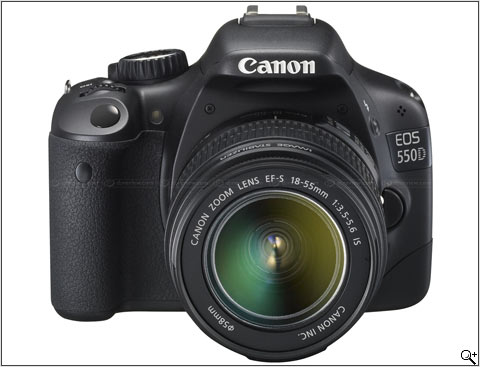
Big news from Canon earlier this week: They announced a new DSLR that is a bold step forward where it matters to me most: price. I’d been holding off on taking the plunge into DSLR filmmaking, because the field is moving so rapidly and I didn’t want to plunk down a couple thousand bucks on something that would be outdated in a few months. But at a retail price of just $800, Canon just removed that concern with the Canon 550d/T2i.

This new camera, which is rumored to begin shipping any day, features virtually the same video capabilities as the 7d, complete with selectable cinema framerates and a fat APS-C sensor. The result, when paired with good lenses, is dreamy shallow depth of field in a handheld camera.

Another big factor for me: This camera uses SD cards! This might not seem like a big deal, but I absolutely HATE having to plunk down the big bucks for different types of media. I already have invested in 3 SD cards that I use in my JVC HM-100, and absolutely LOVE them: they’re tiny, and hold nearly an hour of 1080p HD video per 16gb card. Sweet.

This camera allows me to join what I expect will be legions of videographers who want to take the visual quality of their work to a whole ‘nother level – without breaking the bank. This camera will allow me to put my money where it belongs – on buying great lenses.

This camera doesn’t address the issues that have kept me out of the dslr filmmaker fold previously – it still is a 35mm stills camera with video bolted on. No articulating screen, no good audio features, etc. But at this price, it doesn’t matter. A camera will come along before too long that will fix that, and let me use the glass that I’ll begin buying. I already have two very fast 35mm Nikon lenses that, with a $10 adapter I bought on Ebay, will work fantastically on this new Canon. Thanks Canon for making a game-changing product that allows me to join the DSLR filmmaking revolution.

Man With A Movie Camera | documentary 32 of 100

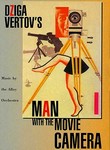
Can a 1929 film made in Russia have anything to teach a beginning filmmaker today? That question was on my mind today when sat down to watch Dziga Vertov’s film, Man With A Movie Camera. The mere fact that you can instant-play the film on Netflix 81 years after it’s release is a clue. This film wasn’t simply trying to show life: its stated intent, shown in brief subtitles that occur mainly at the beginning of the film, is to create a language of film, a cinema without intertitles, without scenario (story), and without actors. In short, it was an act of film rebellion, very much in keeping with the rebellion that he was part of in the fledgling Soviet Union.

Synopsis: Dziga Vertov trains his mechanical eye on ordinary life, composing a visual symphony from a series of carefully paced sequences. A woman rising, streetcars passing, carriages riding down busy streets, athletes performing, audiences watching and many more scenes are explored in slow motion, fast motion, split screen, and superimposed sequences, techniques that are still in use today. Further, he includes himself (or another cameraman) as a character in the film, as the observer and participant in modern life.

Story Structure: Basically when is film is called “experimental,” that means it doesn’t have a traditional story. What that means in this film, is that it simply shows life unfolding in a series of tightly edited sequences, which are cut to music, not unlike Koyaanisqatsi and Baraka would be cut many years later. We see a range of human behavior, from waking up, to a funeral procession. An almost comedic sequence shows one couple signing a marriage contract, followed by an unhappy couple signing a divorce contract. The whole thing is strung together with numerous transportation sequences of trains, streetcars, horse-drawn carriages, and automobiles, on which the camera is sometimes mounted for tracking shots.

Cinematography: First revelation is that 1929 cameras were portable! That caught me by surprise. I always thought the first cameras were huge ponderous beasts that were virtually immobile, but not so. The man with the movie camera is everywhere in this film, with his boombox-sized camera mounted on a wooden tripod, slung comfortably over his shoulder. Lots of special in-cemra effects: for example, there’s lovely fast-motion sequences of clouds moving rapidly over a bridge. There’s a special effect in which people dissolve into a scene that is empty until the person dissolves into it. The film must have been at least a little scandalous in it’s day in filming topless women in mud baths. You get the sense that the filmmaker was very confident in pursuit of his images.

Editing: Split screen technique deployed to show man with camera towering over masses of people. Freeze frame action. There’s even the most basic kind of animation in this film, in a comical sequence that shows the film camera cranking itself and dancing, spider like, on its tripod legs. There’s even a pile of dead lobsters with one animated by hand crawling that’s quite freaky. We see pictures of Vertov’s wife editing the film, which are intercut with images of sewing machines, referencing the metaphor of editor as stitching together reality. The role of the filmmaker is ever present in this film. Rapid fire image sequences are at one point intercut with a blinking eye, cut with blinds opening and closing and finally the lens of the camera with it’s iris opening and closing.

Music and Sound: This of course was a silent film, but it’s not silent in that an orchestra would perform with the films of the day. The filmmaker left notes about how the score should be performed, and the version I saw noted that these notes were followed in the production. What we see a lot is that the musical score is fast and bubbly at times, in which editing matches the score (or vice versa). Other times it slows down, and the pace of visuals matches that. There are basic sound effects – such as a pan being hit every time a machine stamps out a widget.

What I learned about filmmaking from this film is that filmmakers have been pressing the limits of what a camera could do from the very beginning. And that the more filmmaking changes, the more it stays the same. Many of the techniques that we use today go back to the very beginning of filmmaking.

The Sweetest Sound | documentary 31 of 100

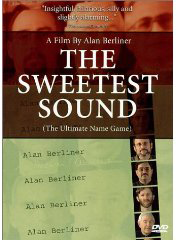
Alan Berliner is a name that keeps popping up in books about documentary film that I’m reading. So I finally decided to investigate the Berliner buzz by ordering a copy of The Sweetest Sound. Turns out there’s a lot to this name. Enough, in fact, to make a 60 minute documentary film. But what this film proves to me is that if you can make a film on this subject, you can make a film about anything. Whether it’s a film worth watching is less clear.

Synopsis: New York filmmaker Alan Berliner launches a personal investigation into the origins of his name with the help of his parents, people on the street, and 12 other Alan Berliners.

Story Structure: Structured as a personal essay, the film attempts to launch a story train with this line from the filmmaker: “when it comes to names, there’s no such thing as community property.” In essence, Berliner lays claim to the name and calls into question the right of other Alan Berliners to “his” name. He sets up a meeting with 12 other of them by flying them to New York and putting them up in hotel. However, there’s no specific challenge, or other “must see” reason to see what happens when the 12 of them meet. In fact, very little happens when they meet. They basically stand around talking as if they were at a Chamber of Commerce event. While it may be a flimsy story train, it is a train nevertheless, and Berliner  then uses interviews with people ranging from his parents to people in the street, to explore what Alan Berliner is all about. Maybe if my name was Alan Berliner, I would care. But it’s not.

This film strikes me as being made for TV, rather than as a film, at exactly 60 minutes in length. I think it would have made a much better 30-minute TV show, than a 60-minute one. That would have allowed for him to edit out the duplicated devices that were interesting once, but not after the 3rd or 4th time.

This film reminded me a lot of Ross McElwee, reflexive filmmaking. But it isn’t nearly as interesting as Sherman’s March. It’s problem, perhaps, lies less in its approach and more in its subject: which topic do YOU think is more inherently interesting: someone’s investigation of their name, or someone trying to find a girlfriend?

Cinematography: There’s one scene in this film that I’ve never seen done before, and I think works extremely well. It’s the last one in the film. The 13 Alan Berliners are all gathered around a round table, and they are having a toast. He put the camera on a lazy susan, and spun it very carefully to follow the glass clinking as it travels all the way around the room, until it ends up on the filmmaker, at which it suddenly stops. This rocked. He used the same technique earlier in the film, as a device to whip-pan through all the guests, to stop on a specific one at the point where that person begins talking.

There are lengthy narrated sequences in which we see circa 1999 websites being clicked and searched on. Perhaps this is interesting for one reason – it shows how badly the web sucked in the years prior to Google. But it’s a tiresome device.

I liked the way he filmed the his nieces, who were swinging. He put camera in front of them on sticks, locked off, with enough depth to keep everything in focus. Works.

Simple animation of name being written works, but it’s predictable after first use, and like many of the other elements in the film, he returns to it again and again. In fact, if there’s one take-home lesson for me from this film, it’s this: Use cool effects sparingly.

Editing: It felt like a 30 minute film edited to be 60 minutes. One innovative thing: He continues narration throughout credit roll. Haven’t heard that one before.

Music and Sound: I don’t recall any music in this film. But what I DO recall, in fact what I wish I could forget, is the never-ending mouse clicking and computer keyboard pressing that this filmmaker made use of. That device was cute for about 30 seconds, but it never ends. Another nice effect: sewing machine sound effect with tombs scrolling past rapid-fire.

While this isn’t one of my favorite films, I give Berliner major props for putting himself squarely in the middle of his films. That’s always a bold move: some people (me) aren’t going to like it. But for those with im the story resonates, it can resonate big time, and Berliner has had great success in getting his films screened at major film festivals and is widely perceived to be an “artist” filmmaker, with his work being recognized with a retrospectives of his films presented at the Museum of Modern Art (NYC). But for me, I’d take a movie theater over a museum as a showcase for my work any day.

"Brothels" baby grows up to become filmmaker

One of the child characters in Ross Kaufmann and Zana Briski’s 2004 documentary, Born Into Brothels, is now attending film school in the United States. A fund set up by the filmmakers to help the children of prostitutes, who were the subject of their Oscar-winning film, enabled 20-year-old Avijit Halder to follow his educational dreams to the United States. He plans to return to India and make a film about one of the other children who was in the film, a girl who has since become a prostitute.

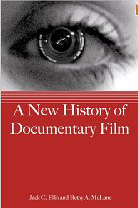
A New History of Documentary Film

As I’ve immersed myself in documentary films over the past 3 months, I’ve gotten more curious about the history and tradition that informs the films being produced today. I found myself wondering, who made the first documentary film? Where did cinema verite come from? How come Canada has a national film board that supports documentary filmmakers and we don’t? So I picked up a used copy of A New History of Documentary Film, which is written for classroom use, by a pair of academics, Jack Ellis and Betsy McLane.

After reading this book, I’ve got a solid picture of where documentary film came from, who the major figures were and are, and why documentary developed differently in Canada, Great Britain and the US. It’s a young medium, really, when you consider the first feature-length documentary ever made, Nanook of the North by Robert Flaherty, was released in 1922. What’s really cool, is that very first film is still in print – I was able to request it on Netflix and I’ll be screening and reviewing it next week.

I also picked up a raft of new names that I’ve added to my “must see” list: filmmakers like Dziga Vertov, John Grierson, Pare Lorentz, Colin Low and Wolf Koenig, Robert Drew, Jean Rouch, Pennebaker and Al and David Maysles. I’m also now planning to screen films by Frederick Wiseman, Ricky Leacock, Les Blank, Nick Broomfield, Rob Epstein, John Else, and many others.

It was fascinating to discover just how much successive generations of filmmakers have been influenced by each other’s work. For example, Michael Moore was influenced by filmmaker Tony Buba, who began making films in a similar personal style about similar subjects as Moore, in similar part of the United States (and in fact Moore hired Buba’s editor to work on his first film Roger and Me).

The book reads like the college textbook that it is, so you won’t find particularly colorful or impassioned or entertaining descriptions of anything – it’s just the facts, presented simply and briskly. It’s a fantastic jumping-off point for further reading, with additional books referenced at the end of every chapter. Further, there’s a fantastic suggested viewing list of films at the end of each chapter as well.

Gates of Heaven | documentary 30 of 100

After watching Gates of Heaven, I can understand why Errol Morris found the theater completely empty at the end of it’s first screening at the Berlin Film Festival. I’m also beginning to recognize the subtle thing that makes a filmmaker potentially great. It’s visible in this film. Roger Ebert saw it, and put this film on his top 10 list of best films of 1978. Here’s my stab at describing it: it’s not necessarily a filmmaker’s ability to record great on-screen action, exotic locations, or big budgets. It’s his ability or need to transcend the subject at hand and turn it into an exploration of deeper questions. In this case, it’s about success and failure, and life and death.

Synopsis: When a poorly run pet cemetery closes and 450 animals have to be dug up and moved to a more successful cemetery, first-time filmmaker Errol Morris introduces us to the failed owners and the successful owners in a series of interviews that raise questions about business, death, and the banality of existence.

Story Structure: In a fascinating preview of his later style, Morris structures the entire film around interviews in which the characters at times directly address the camera, but most often look close beside the camera in telling their stories. The film is roughly in two halves; the first half deals with the failed cemetery owners telling their story, and the second introduces us to the successful cemetery owners and their stories. The interviews slowly reveal character. Morris’ voice is not present, as it is in later films. The film gets really interesting toward the end as the Bubbling Springs cemetery owner talks about God and we realize that the religion he created for the pet owners convenience is really no different from the religions of the rest of the world.

Cinematography: The interviews are all different, but they are set up to say something about the person. For example, filming the oldest son with all of his trophies on the wall, or the dad with a name plaque on his desk, or the owners of the failed cemetery with an open can of Coors. Simple backgrounds work wonderfully – cactus behind pet owners, dry grass behind pet owners, and nothing else.

Intriguingly, the film is almost entirely interview, and it works (but that’s likely why most people walk out on it – it’s a bit tedious to sit through a feature that’s mostly interviews for many people). There is light by highly effective use of b-roll to illustrate the story: for example, there’s a couple of newspaper headlines illuminated by light falling just on the headlines, the rest of the page in shadow. There are shots of the cemetery location, and of workmen digging out the bodies of pets. There’s a shot of a guy drawing what he’s talking about on a pad of paper.

Editing: Morris is credited as the editor, producer and director of this film. I read somewhere that he consulted with a ton of editors who didn’t think they could make a film out of the footage, so perhaps he had no one except himself to edit it! One moment in the film feels really tacky, when Morris inserts a newspaper headline by doing the old-school spinning-spinning-spinning paper which suddenly stops and we see the headline. It was almost like, hey, I figured out how to do this technique so here it is. Kind of like I was doing on Final Cut yesterday.

Music and Sound: No music in the film except two memorable scenes in which the youngest son of the pet cemetery plays music he’s recorded on a tape recorder, and the second scene where he hooks up his guitar and blasts it out over the cemetery. There are a number of airplanes heard droning overhead while someone’s talking in an interview, car noises from busy streets during interviews, people talking a bit in background. But it manages to work.

As an interesting aside, this is the film that Werner Herzog famously ate his shoe over. Apparently, he had observed that Morris had an inability to complete projects that he started. Morris proved him wrong by completing this film. And a few others since then.

Land of Silence and Darkness | documentary 29 of 100

What intrigues me about this 1971 film by Werner Herzog is how straight-up it’s shot, narrated and structured. In Land of Silence and Darkness, it’s almost like he wasn’t sure what to say about the subject, so he let her speak for herself. So to speak. And she has plenty to say, even though she’s deaf and blind. At the time this film was made, people with disabilities had not yet received the kind of attention that would improve their living conditions in later decades. This film probably played a role in helping bring awareness to the issue, but in the end it is a compassionate examination more than a rallying call to action.

Synopsis: What’s it like to be deaf and blind? Meet Fini Straubinger, a German version of Helen Keller, who somehow maintains a strong connection connection to people around her and a genuine interest in helping others locked in a prison of darkness and silence. She’s able to speak better than most, because she didn’t lose her vision or or hearing until she was a teen. The film features lengthy sequences of others who are less fortunate than her, in various stages of development. In the end the film is less a story with a beginning, middle and end, and more an investigation into the nature of being, and a metaphor, perhaps, for humankind’s struggle to grapple with the big existential questions.

Story Structure: The film (in German with subtitles) is structured around the story of Straubinger, and she tells the story herself in an interview setting. The first part of the film is mostly blackness with only her voice retelling what she remembers of seeing, and when she describes something particiularly vivid (such as clouds or ski jumper) we see momentary clips of these things. Great way to get into the film. The opening sequence ends with Straubinger sitting on a bench with her interpreter who is asking her questions for Herzog by spelling the questions into her hand.

Narration when used is NOT Herzog’s voice (he had someone else do it),  and it merely elucidates facts, rather than offering comment or reflection, as his later more personal films do. We spend a lot of time in the film with other characters, simply observing what their lives are like: a birthday party, taking a swim, a visit to a cactus garden in which all the blind eagerly touch the sharp cacti as if stroking a pet. One uplifting scene early in film is when Herzog arranges for two of the blind ladies to take their first airplane ride.

Cinematography: Even this early in his career, Herzog did not shoot his own films. The cinematographer on this film was a frequent collaborator with Herzog, Jorge Schmidt-Reitwein.

Editing: Lots of very long sequences without cuts of any kind. Most everything else simply cuts. Family photos are simply displayed in frame, with arrows showing who she is, with no movement of any kind within them.

Sound and Music: Orchestral, classic music. Haunting violin and strings. Some of the audio recording isn’t that great, suggesting low budget film made by a couple people.

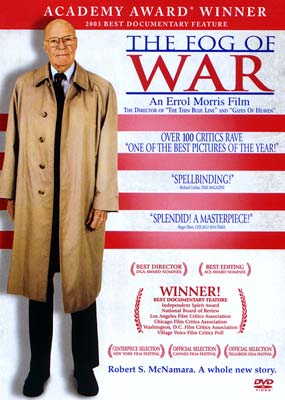
The Fog of War | documentary 28 of 100

In continued honor of editor Karen Schmeer, who was killed by a hit-and-run driver last weekend in New York, last night I screened The Fog of War, the most acclaimed film she worked on. I was surprised to see that she was one of three editors listed in the film, which is directed and produced by Errol Morris. Which leaves me curious why Morris uses more than one editor on many of his films. I did a little Googling and found an interview in which Morris explains how he went through half a dozen editors on this first film before he could find someone who could make a film out of his footage. Fog of War, though, began as TV series he ran briefly, called First Person, in which Morris interviewed interesting people for 30-minute episodes. He had the idea of inviting Robert McNamara, and the 30 minute interview was so good, that he knew it had to become a film.

Synopsis: Former Secretary of Defense Robert McNamara, widely regarded and reviled as the architect of policy that resulted in the Vietnam War, recounts the story of his life and muses on the lessons he’s learned about the limits of power.

Story Structure: The film is interview-driven, and structured around  11 lessons from McNamara’s life, which serve like chapters in a book to break the film into distinct parts, which loosely follow a chronology of his life. The classic elements of Morris filmmaking are all here: Penetrating eye contact with the interview subject, supported by news footage, historical photos, and occasionally the voice of Morris asking questions.

Cinematography: Memorable shooting/editing technique: This is the first time I’ve ever seen a sequence played in show motion, with fast-motion layer running over it simultaneously. The result is a dreamy state, a pause in the pace to reflect on the words that are being said, a disassociation with reality, stepping into another world. It’s a device used repeatedly throughout the film, and it’s killer. It was used when someone is flipping through pages of an open book, and also to show people walking down a street. He uses it again to show the Vietnam Memorial – with people lingering in slow motion while people rush past at a fainter percentage of visibility. It’s a beautiful technique that I’m totally going to borrow and build on in my own work.

There’s a memorable scene which plays forwards and later in the film backwards, which shows dominoes falling across a map of the world. This is of course a reference to communism taking over the globe, the rationale for getting deeper involved in Vietnam. It’s shot at a high frame rate, and played in silky slow motion. The b-roll of tape recorders (with shallow depth of field) is also shot in slow motion, looks really beautiful, and works against the tape recordings it’s paired with.

The film is wrapped up with a series of shots of McNamara driving in his car through rain-soaked streets. It’s beautifully shot: close up on his glasses reflecting trees passing by, but with his eyeball huge; top of his head and rain-dropped window above. It reminded me a little of the driving scenes of Al Gore in Inconvenient Truth, only Gore as a passenger in those. The fact that McNama is driving himself seems to portray how his time and come and passed.

Editing: What’s different about this film from most Morris films, and mildly disconcerting, is the amount of jump cutting. I’m pretty sure it was included for a reason: to show how difficult it was to get McNamara to answer in complete sentences, and to show how much he attempted to steer the conversation.

An interesting editing technique (which might more probably be called an animation or special effect technique) was a shot in which the camera floats down a column of falling bombs (animated, presumably, but begins with a still B&W photo and it’s like we can travel into the photo, and down among the bombs, which drift past us as we continue down into them. It’s way more powerful than the typical zoom and pan on photographs for it’s impact to draw you in.

Playing things backwards is also a recurring device used in this film to show that things we thought happened actually didn’t. For example, the torpedo boats that supposedly attacked US warships in Vietnam, and were the inciting incident for massive bombing by the US, in fact never happened.

The film ends with a powerful line delivered by McNamara, who is quoting TS Elliot:

We shall not cease from exploration
And the end of all our exploring
Will be to arrive where we started
And know the place for the first time.

Music and Sound: Philip Glass again provides the soundtrack for the entire film, as he does on previous films like Thin Blue Line. My main critique is that if you’ve heard one Glass soundtrack, you’ve heard them all. The music is almost invisible to me in the film, and maybe that’s why Morris keeps returning to this composer, to keep the attention on the subjects with as much force as his Interrotron.

Rethink Afghanistan | documentary 27 of 100

The first thing I noticed about Robert Greenwald’s filmmaking in Rethink Afghanistan is how seriously he cut corners to make the film. For example, seconds into the film, the image quality takes a huge hit as we watch footage he must have pulled off YouTube. Soon after that is an interview that sounds like it was recorded in an echo chamber, the result of inexcusably sloppy audio work. So, is it any surprise that the second thing I thought was: if he cuts corners this seriously in production, with what care does he handle the facts?  I’m sympathetic with the primary charge he levels with this film: that this war is having in many cases the opposite effect from the story we tell ourselves. But there’s something off about a filmmaker who’s in such a rush to make a film that he can’t move the microphone a little close to the subject’s mouth to get a clear recording.

Synopsis: In a rapid-fire sequence of interviews, news footage, and photos, Greenwald lays out evidence for the case that the United States is making a huge foreign policy mistake by pursuing the war in Afghanistan, and in fact, making the situation there worse.

Story Structure: The film is breathlessly structured around a series of “myths,” which are each quickly brushed aside by a fast-moving parade of interviews and other evidence. For example: “Women are better off in Afghanistan now that the US has removed the Taliban.” Cut to photo of a woman whose face has been eaten away by acid splashed on her by Taliban for showing her face in public. Cut to interview of an Afghan woman saying she fondly remembers the Taliban days, because at least they could stay inside and be safe. Cut to an academic talking about how women are bearing the brunt of violence in the war. The only thing we never cut to is someone acknowledging anything other than horror. Come on, there’s NOTHING good about the Taliban being gone? I’d be more likely to believe his evidence if he at least acknowledged some of the upside. There are so many fast-moving facts, that it seems, there’s no time to even acknowledge other points of view.

Cinematography: Bad. The interviews have no consistency between the way they were shot and lit and many have appalling audio. In fact, it was difficult for me to tell from watching the film whether the filmmaker was actually IN Afghanistan at any point in the filmmaking – it feels like the whole thing is stitched together from news footage and photographs, and interviews that could have been made just about anywhere. Because the quality of the footage varies so greatly, it feels like it was all found somewhere rather than being shot for the film specifically. To give some credit, the b-roll does support the things the interviewee is talking about, often very literally, rather than with much finesse.

Editing: The pacing of this film is way, way too fast. I found myself holding my breath at times, because I thought I was drowning in facts. Facts that I didn’t even have time to question in my own head before new facts were trotted out as further evidence, which are in turn replaced with further, different facts. Makes you crazy after awhile.

Music and Sound: One sound effect I liked is the “swoosh” sound effect that accompanies the flash transition used in the film. The music is in the background adding to the relentless rush of the film.

Bottom line: While I appreciate the filmmaker’s intentions, this film is what low-budget journalism would look like if it didn’t have to drag the burden of fairness around. By slowing down, doing a better job in production, and at least acknowledging the existence of alternative points of view, this could have been a much better film.

Lemonade | documentary 26 of 100

Seth Godin did something he doesn’t usually do earlier this week: he raved in his blog about a documentary film. “The Lemonade movie is so professional, engaging and inspiring that you’ve probably already seen it. If not, here it is.” I wish it were true that possessing those qualities made it probable that a film would find an audience. If so, there would be as many people crowding into theaters to watch The Cove (my Oscar pick for best doc) as there are lining up to see Avatar. But that’s another story.

Synopsis: Devastated when they are laid off from their ad agency jobs, former employees tell how they found courage and means to turn their perceived misfortunes into golden opportunities to create businesses that better reflect who they are and how they want to live.

Story Structure: Interviews are the spine of the film, which are structured in three acts: 1. Laid off – oh crap. 2. What am I going to do about it? The characters reach a point where they decide to take matters into their own hands. 3. As a result, they find happiness and inspire others.

This structure, incidentally, is essentially the same structure of our film Shine, except that our first act was people leaving by choice, because they hated their jobs.

Cinematography: One word: stunning. These are some of the most beautifully lit and shot interviews I’ve ever seen in a film. The production values were very high, from gorgeous introduction sequence with lemons bouncing around shot at a high frame rate and rendered in silky slow motion, to the detail shots of characters hands, to the sparse but stunningly beautiful b-roll from the lives of the characters. Who are mostly all beautiful. Most everyone is fairly young, too. It looks like the film was produced by an ad agency. Oh wait, it was! Ha ha. They did a great job applying their skills to the task, and the result is an effective sales pitch for DIY career management that looks like an ad for a BMW.

It had to have been shot on a Red Camera or maybe just a Canon 5d. Something with one hell of a fat sensor, because the depth of field is so shallow, they had a hard time keeping the interview subjects in focus – if they leaned forward to make a point, even an inch, they were out of focus. It’s the kind of cinematography that I call “shallow depth of field porn.” One thing about lighting: it appeared to be relatively simple soft source key, without any rim light. There was always darkness surrounding the interviewee for drama, but light in background to set them off the background, which was carefully exposed just right so the highlights were never completely blown out. The background light often has a soft color to it – the orange of a lampshade for example.

The b-roll was often very small things, details: hands fidgeting, lots of focus pulling, limbs cartwheeling through yoga class, coffee beans that looked good enough to eat, milk being poured into coffee as if it were a Starbucks commercial, veggies being chopped. Still photos were jump-zoomed into like you see on network TV – from small to medium to big in three distinct steps, rather than zoomed steadily into, which is the more filmic way. They even found a way to use the side angle of the interviewee’s face as b-roll, cutting to shots of person just looking at camera while their voiceover continues. It all adds up to make them larger than life, heros.

Editing: Spare use of b-roll to accompany the interviews, which are shot so beautifully that I’m glad they stayed on the faces as long as they did. An interesting departure was no slates for any of the characters. Instead, at the end of the film they all state their names and we cut through all of them, sort of like all the performers take a bow at the end of a play. The recurring use of lemons worked but felt a little overdone, but they look so good you can’t help but but enjoy watching them roll by in slow motion or get chopped up or just glide by. Editing did a great job of intercutting the different characters so that they are all talking about the same thing, moving the story forward together by completing each other’s sentences almost.

Music and Audio: Music (credited to Caspian) is mostly quiet guitar riffs build the mood. Soft, sparkly keyboard riffs.

A lot of talented people worked on this film, and it shows. Bravo for an inspiring film that raises the bar on what documentaries of this kind can look like: gorgeous.