Fix clipped audio recordings with iZotope RX2 declipper

If you’ve been reading the same audio books as me, you’ll know that the cardinal sin of digital audio is recording too hot. You NEVER want signal above 0 db. Once that happens, you might as well throw the whole thing out and reshoot. Or so the experts say.

But this weekend I messed up. I wired a lav to a Zoom H1, planted it on my subject, took a guess at the recording levels, hit record and let it roll for 8 hours (until the batteries died – it was a long day). Later in post, I synced everything I’d shot during the day with PluralEyes. Piece of cake…except that my subject was in and out of cars, working crowds, basking in applause, oh, and he happens to be Italian, no stranger to high-spl outbursts when cute girls are nearby. Every time one of those things happened, I got clipped audio. Next time, I’ll remember to set the audio levels REALLY REALLY LOW. But what about THIS time?

I looked up audio clipping on Wikipedia, and breathed a sigh of relief when I read this: “It is preferable to avoid clipping, but if a recording has clipped, and cannot be re-recorded, repair is an option. The goal of repair is to make up a plausible replacement for the clipped part of the signal.” Wikipedia even pointed to a couple of tools. But none of them worked for me.

I figured somebody had to have an app for this. And I was right. After some digging on Google, I discovered an an audio repair app called iZotope RX. Their video is a great overview of how it works:

After trying out the demo version for 30 minutes, I was happily forking over my credit card number for the $250. Yep, it’s really that good. And a snap to use. It comes with a whole suite of other audio repair tools, such as a de-crackler, de-hisser, and de-noiser. And best of all, they work as plug-ins with Soundtrack Pro, so I can stay inside my favorite tool to use them.

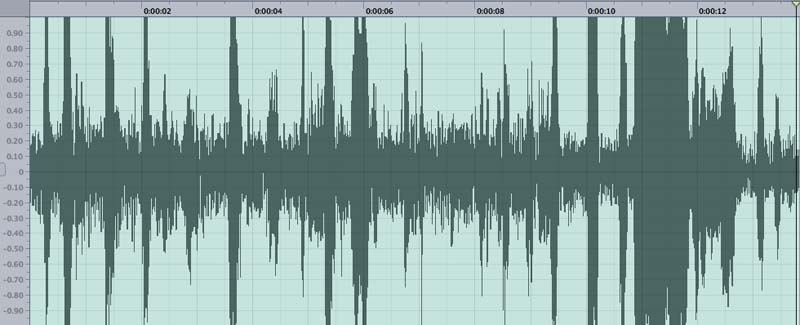
Here’s what my audio looked like in Soundtrack Pro BEFORE iZotope:

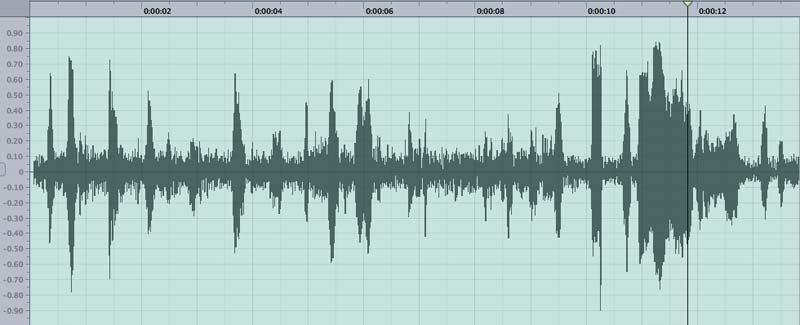
And here’s what it looked like AFTER iZotope RX de-clipper:

Have a listen to the difference yourself:

Before

After

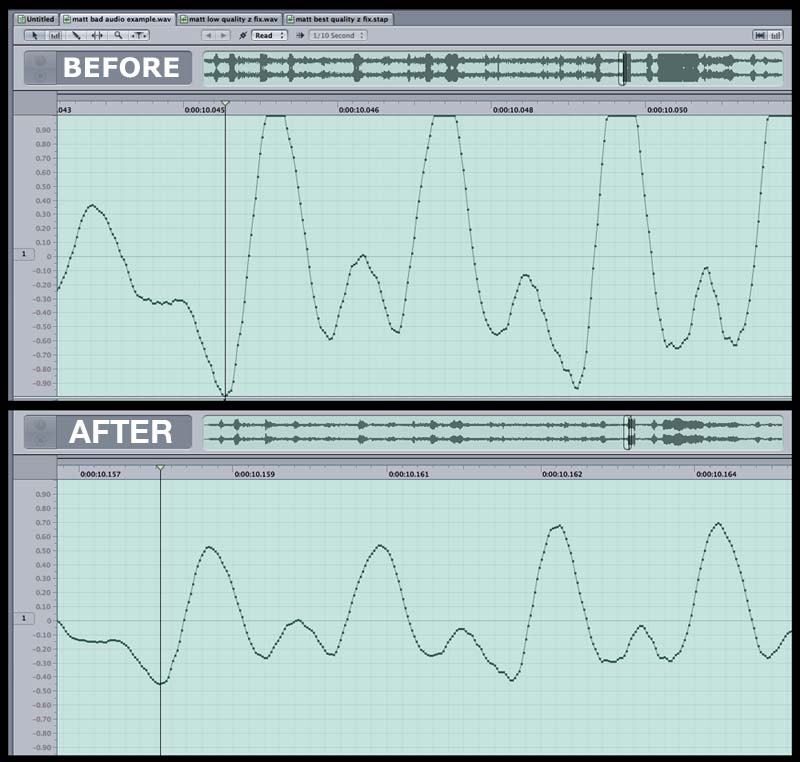
And finally, here’s a peek at what iZotope does to the individual waveforms: it actually creates data where none exists, presumably based on a careful analysis of what other nearby good peaks sound like. Whatever. I’m with Arther C. Clarke, who in 1961 said: “Any sufficiently advanced technology is indistinguishable from magic.”

Shooting wide open: what a difference a stop makes

Check this out: a simple shot of a lamp in my back yard, at different apertures on open end of my prized Nikon 35mm 1.4 lens. This is the lens that Nikon made during the 70s using radioactive glass (really) and as a result, today the lens has a very warm cast caused by the decaying isotopes. It’s the perfect lens to warm up those cool cloudy days in Seattle.

But that’s not what caught my eye about this sequence. What I’m blown away by is how very, very different the image looks at each of these apertures. Check out the huge difference between 1.4 and 2.0, for example. All the way open, the background almost looks painterly, like you can see brush strokes. But the detail in the foreground is noticeably less sharp. That cleans up instantly at 2.0. The background strokes are still there – just a hint. This is pretty much the sweet spot of this lens.

Anyway, no reason for sharing this today except that it’s good to remember exactly what your lenses can do, and shooting a series like this really makes it startlingly clear.

Glif iPhone 4 tripod – $20 reserves yours

I’ve been a Kickstarter member for awhile now, but this is the first project I’ve helped fund: The Glif iPhone 4 tripod. It’s a slick, simple little device that attaches to your phone and turns it into a tripod, as well as a stand, and an antenna protector. I’ve already got a tiny tripod for my iPhone, but it was so cheaply made that it broke in the first 48 hours of use, and is now limping.

I hope the overwhelming success of this project – which has already received more than 600 percent of the money it set out to raise – sends a message that there is a lot of demand for well designed video and photo related accessories for iPhone 4. It’s a great little camera, and with this, even better.

New work: short web video for Columbia City's BeatWalk

I shot this wonderful pro-bono gig over several BeatWalk evenings this summer, and then got busy and couldn’t find time to edit it until 4 am this morning – 5 hours before the Beatwalk board was meeting to review it. I made the deadline…although I didn’t have the color corrected and audio sweetened version wrapped until this evening. Anyway, it’s done, I like it, and best of all, the client likes it. Sigh, without deadlines, I’d never get anything done. Next!

Special thanks to BeatWalk organizer Julie Dillon, who produced the video and recorded audio for me.

Producer – Julie Dillon, BeatWalk Coordinator
Voice 1 – Darryl Smith, BeatWalk founder and current Deputy Mayor of Seattle
Voice 2 – Andrea Davis, Columbia City Citizen
Interview – Oleg Ruvinov, Musician, New Age Flamenco
Recording Studio – Columbia City Theater

More info at http://columbiacitybeatwalk.org.

Canon 60d in two words: thank you

Canon’s brand-new 60d camera doesn’t represent a significant video technology breakthrough. So why am I so happy to have one in my hands this morning? The image quality is virtually identical to the 7d, it doesn’t autofocus faster, and its sound capabilities already exist on the 5d. Never mind. I was happy to pay the extra $50 so I could have this beauty delivered to my house this morning from the first place in the country to stock them. Why? For one reason: the articulating screen.

This small, low-tech addition is the difference between wanting to use my DSLR and actually using it. I shoot on a Steadicam Merlin a lot, and having this articulating screen means I’ll be able to use a Canon DSLR without flying blind.

And for “normal” shooting? If I had a quarter for every time I cursed Canon for making me break my neck or lie on the ground to peer through the back of the camera to get a low-angle shot, (which is like half of the time I’m shooting), this camera and the extra shipping would have been paid for long ago. Nice work, Canon!

I’ll be shooting with the Canon 60d this weekend and may have more to say about it. But I doubt there’s much more that needs to be said than this. Oh, maybe one more thing: here’s my recipe for balancing Steadicam Merlin on the Canon 60d (with Canon EFS 18-55mm lens):

Front weights: 1 mid, 1 finish
Lower weights: 1 start, 1 mid, 1 finish
Arc size: 10.75″
Mt. hole: M
Z: -3
G-platz: no

Record salmon run hits British Columbia

Something incredible is happening in BC right now: Salmon are returning home in record numbers. As many as 25 million sockeye are estimated to be migrating just one year after last year’s record low run of 1.7 million.

I was in British Columbia last weekend for a family reunion, and we camped along the banks of a tributary of the Fraser River. We didn’t see any salmon in the river. The next morning we went for a hike downstream and found this unbelievable rapids, and all the salmon were on the downstream side of it. Not one salmon could make it through. It rained all that night. We returned to the rapid with my video camera the next day, and discovered that with the extra water in the river, the salmon were on the move and a few of the strongest ones were able to make it.

It really is quite a spectacle to see these huge fish coming home. I cut together a one-minute film with highlights. Enjoy.

Miguel Gomes in Seattle tonight for NW Film Forum screening

It’s like the people at NW Film Forum have been reading my mind lately. First, they bring Vincent Moon to town, and he puts on a workshop that blows me away. Now Miguel Gomes is in town for a screening of “Our Beloved Month of August.” I put that film on the top of my “must see” list after reading the Sept. 2 NY Times review of the film, which noted how artfully it plows the rich territory between documentary and fiction. Only, I’m not in New York, where the 2008 film opened earlier this month, and it is nowhere to be found online, so what a delight to find that not only is it playing tonight at NW Film Forum, but the director will also be present. Can’t wait. Here’s the trailer, sans subtitles:

Warren Etheredge Art of the Interview workshop starts Monday

I attended this workshop a year ago, and took my interviewing skills to a whole ‘nother level. Etheredge is a real master who share skills he’s learned from more than 1,500 interviews with cultural figures from Charlie Kaufman to Chuck Palahniuk. This Art of the Interview workshop begins in Seattle on Monday, September 13th at 6pm. Here’s the details from the event page:

“Warren Etheredge is an extraordinary interviewer — one of the best in the country. He’s incredibly prepared for each encounter — and has an uncanny ability to absorb complicated material and distill it for audiences. He also has a terrific sense of humor that makes the interviews feel less like dutiful graduate seminars and more like a late-night talk show. Indeed, I think it’s only a matter of time before some media executive wises up and gives Warren his own show.” — Daniel H. Pink, author of DRIVE and A WHOLE NEW MIND

“Warren is the most knowledgeable and engaging interviewer and commentator on film that I have ever been engaged with. His insight and criticism are tempered with a keen sense of humor and irony. To be the subject of one of his filmmaking classes was both intellectually stimulating and a whole lot of fun.” — James Foley, filmmaker (GLENGARRY GLEN ROSS; AT CLOSE RANGE)

“…I found [our] conversations about 4 times more fun and thought-provoking than any other moderated talks in which I’ve participated.” — David Benioff (screenwriter, THE 25TH HOUR; THE KITE RUNNER; WOLVERINE)

“Warren Etheredge is one of the most probing and thoughtful interviewers–not to mention the wittiest!” —David Grann, author of THE LOST CITY OF Z

Tuition for this intensive workshop is $100. ($75 for graduates of TheFilmSchool’s Summer 2010 session.)

I am always flattered by the (unsolicited!) feedback I receive from the folks I interview. I am thrilled they appreciate the spirit with which I approach interviews. (Owen Schmitt , formerly of The Seattle Seahawks, refers to my style as “chill”… and who am I to argue with the 6’2”, 247 pound fullback?)

Now you can learn how I prepare for interviews and how I respond to the different challenges presented by questioning folks on tape, on camera or before an audience. And, I’ll share insights and a little bit of gossip from the 1,000+ interviews I’ve conducted with the likes of Woody Allen, Amy Sedaris, Calvin Trillin, Naomi Watts, Robert Duvall, Mariel Hemingway, Salman Rushdie, Nora Ephron,Michael Pollan, Charlie Kaufman, Augusten Burrough, Andy Samberg, Vincent Bugliosi, Nicolas Cage and others.

You’ll learn why documentarian Peter Esmonde says: “I was more relaxed being interviewed by you than anyone before or since. It’s so clear that, aside from being attentive and intelligent, you know [your stuff] — and that makes the interview more of a conversation with a compadre.”

The venue for this special intensive will be the Phinney Neighborhood Association (6352 Phinney Ave N, Seattle WA 98103)

Tuition for this exclusive, 3+ hour workshop is only $100. You may mail check or money order (made payable to Warren Etheredge) to: 1752 NW Market St #118, Seattle 98107. Or, pay using PayPal, sending money to warren@thewarrenreport.com

Space is very limited, so please reserve your seat today and indicate you’ll be attending on Facebook.

About me… As founder of The Warren Report (www.thewarrenreport.com), Warren Etheredge — America’s premier cultural conversationalist — curates and hosts over 200 events every year, a podcast and television series. The Warren Report promotes “slow culture” through commentary, outreach, events and education. He is the host of The High Bar, a television series that airs weekly on SCANtv. Warren has conducted over 1,500 interviews — in print, on camera, on stage — with a wide range of filmmakers, personalities and smarties including Amy Sedaris, Darren Aronofsky, Michael Pollan, Charlie Kaufman, Naomi Watts, Salman Rushdie, Robert Duvall, Alexander Payne, Nora Ephron, Augusten Burroughs and Chuck Palahniuk. Additionally, Warren is one of the founding faculty of TheFilmSchool, along with Tom Skerritt, Stewart Stern, Rick Stevenson and John Jacobsen. For six years, Warren served as the Curator for the 1 Reel Film Festival (at Bumbershoot), before that, he worked with the Seattle International Film Festival. Warren has staged over 40 plays in New York, published five books, written countless magazine articles and recently completed a feature-length documentary, HUMOR ME. He is the host of Words & Wine, The Good Life and the Biznik Innovators Series, conversation series with A-list authors, and is a regular contributor to Seattle’s premiere public radio station, KUOW. He speaks at festivals and conferences nationwide including The Screenwriting Expo, The NAMAC Conference, The International Food Bloggers Conference, The Austin Film Festival and Conference and Bastyr University’s Founders Weekend.

Zoom H1 as "wireless" lav = 4x cheaper


I’m going to make this a really brief post and let these images do most of the talking. Here’s two configurations that I’m now using for attaching a professional Tram TR50 lavalier mic on subjects for recording dialog. The first is with my Sennheiser G3 wireless system, which I love. But it costs $1,157.

Compare this with a system I’ve put together using Zoom H1 and a hardwired version of the Tram, which I found on eBay for $150 bucks. (Granted, this isn’t strictly an apples-to-apples comparison, or I’d have listed the full price of the Tram in each configuration. But I’ve found it easier to find the hardwired version of the TR50 on ebay, and harder to find the same mic wired for Sennheiser there.)


The image above shows what each configuration looks like when it’s hooked up and ready to roll. As you can see, the Sennheiser wireless wins hands-down in terms of compact size. But the wired version is surprisingly compact, and will hide under a shirt easily (unless it’s a tight t-shirt, in which case it’s a bit bumpy). Another drawback to the Zoom H1 is that there is no way to monitor recording. And if the subject sits down, leans back and accidentally presses the big red “on/off” button against the couch, for example, you may not be recording at all. I wish the Zoom H1 had a lock button for this reason. Update: Dmitry posted a comment explaining that there IS a lock function on the H1 (and also on the H4N) – to activate it, simply push the on/off switch toward the “hold” position – voilas – keys are all locked. Awesome.

Despite these few limitations, here’s the bottom line: The Zoom H1 used as a “wireless” lav is 4 times cheaper than the Zoom H4N configured with Sennheiser wireless. The audio quality that both systems produce is comparable, as I’ve pointed out in my H1 vs. H4N sound test previously.

There are also some advantages to using a wired lav – namely, you don’t have to worry about getting too far away from the subject, or interference from others using same frequencies, which can be a hassle in crowded news gathering situations such as a trade show floor.